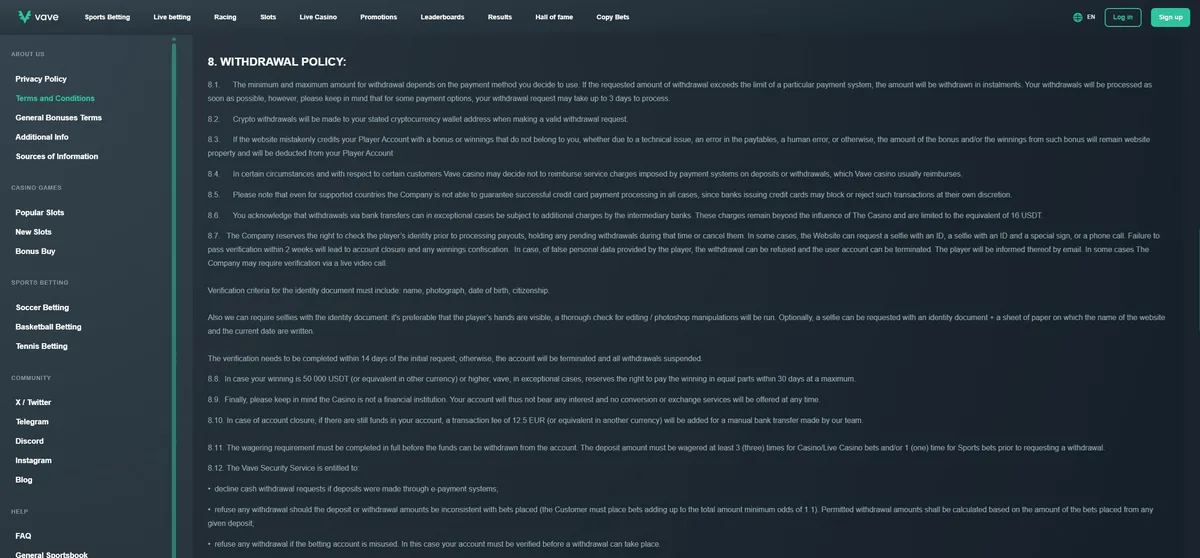
Vave
Vave- Supported Coins
- Not Disclosed
- Pre-verification Limit
- Not Disclosed
- License
- Not Disclosed
From license verification to reading the terms
Operator verification
This page deals with verification procedures, not user reviews. It organizes, on a documentary basis, the license number lookup, balance forfeiture terms, and the limitations of community reports.

 Rocketpot
- Supported Coins
- 13
- Pre-verification Limit
- 원2,500
- License
- Curacao
 Bitcasino.io
- Supported Coins
- Not Disclosed
- Pre-verification Limit
- 2,500 EUR
- License
- Curaçao Gaming Authority
 Wild Fortune
- Supported Coins
- 10
- Pre-verification Limit
- Not Disclosed
- License
- Anjouan Gaming Board
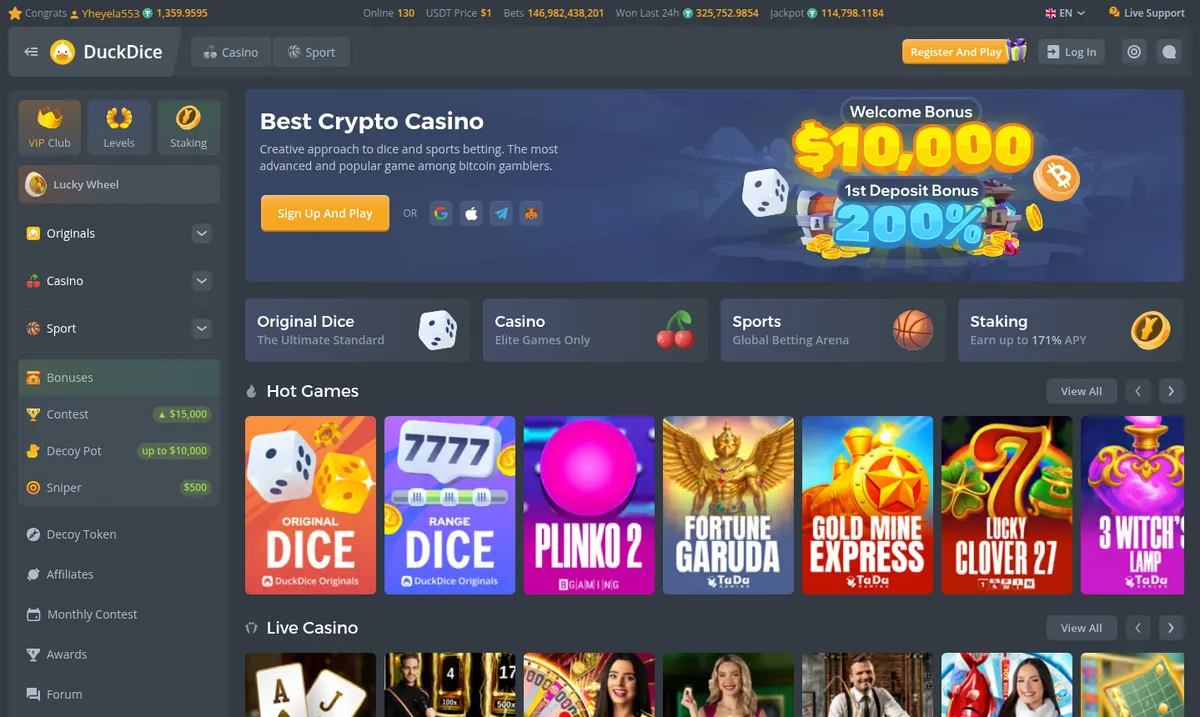
 DuckDice
- Supported Coins
- 10
- Pre-verification Limit
- Not Disclosed
- License
- Anjouan Gaming Board
 Empire.io
- Supported Coins
- Not Disclosed
- Pre-verification Limit
- 2,000 USDT
- License
- Anjouan Gaming Board
 Metaspins
- Supported Coins
- 8
- Pre-verification Limit
- Not Disclosed
- License
- Curaçao Gaming Authority
- Supported Coins
- 9
- Pre-verification Limit
- Not Disclosed
- License
- Anjouan Gaming Board
 Shuffle
- Supported Coins
- 6
- Pre-verification Limit
- Not Disclosed
- License
- Curaçao Gaming Authority
 Wild.io
- Supported Coins
- 12
- Pre-verification Limit
- Not Disclosed
- License
- Curaçao Gaming Authority
Why verification procedures are necessary
Collecting other people's reviews is not verification. Reviews only describe an experience at a specific point in time and do not tell you whether the operator's practices have changed since. That is why the Coin Casino archive does not use the term 'scam verification' as a community recommendation list. Instead, it checks procedures that leave a document trail, such as licenses, terms, and registry lookups.
The market covered by this page is South Korea, and the currency is the won. Legitimate gambling industries in the country are supervised by the National Gambling Control Commission, and the relevant law is the National Sports Promotion Act. Overseas operators are outside this system, so in many cases they cannot be verified in the same way. The verification procedure must first distinguish which category an operator falls into.
The reason procedure matters more than results is simple. Without a procedure, the same site can look safe one day and risky the next. Verifying according to a procedure leaves a record, and that record can be cross-checked later.
Which registry to use for a license number lookup
Domestic legitimate operators must disclose their license numbers, and those numbers can be looked up in the public records of the National Gambling Control Commission. It is accurate to consider an operator whose number cannot be verified as being outside the domestic legal framework. Just because a site shows a license number does not mean you should believe it right away; you should cross-check that the same number appears in the registry.
Overseas operators may not appear in the domestic registry. In that case, you must separately check the registry authority and issuing number of the country where the license was issued, but not all overseas operators disclose this information. Undisclosed information is unverified information, and no guarantee can be given in that state.
When checking, you should not only look at the license number's notation but also confirm that the operator name and the operating entity match. Even if the number is valid, another company may be using it. This is a step that scam-verification sites cannot replace with their own scores.
Where to read the balance forfeiture clause in the terms
If you cannot read the entire terms, at least look for the clauses on forfeiture and bonus cancellation. Usually under headings such as 'account termination', 'fund forfeiture', or 'fraudulent use', there is language stating that the balance can be recovered. If this clause is absent or ambiguous, the operator is seen as having considerable leeway to handle balances arbitrarily.
Having a forfeiture clause is not automatically a bad thing. What matters is what actions the clause covers, whether there is a notification period, and whether there is a procedure for users to raise objections. A clause lacking these three gives the operator excessively broad discretion.
When reading the terms, you should also record the version and the effective date. This is because if a dispute arises later, the changed terms may apply instead of the terms that were in effect at the time. That is why the verification process does not end after one reading; it is standard to review the updated terms again before each deposit.
Limitations of community reports on scam verification
Community reports are not evidence; they are reports. A reporter may be an actual user, or the post may be from a competing operator. That is why different claims arise about the same incident. Therefore, you should not definitively judge an operator based solely on posts from scam-verification communities.
When reading a report, you should check whether documented materials such as screenshots, transaction history, or terms and conditions are included. Reports without supporting materials are classified as unverifiable information regardless of the strength of the claims. The Coin Casino archive refers to community reports but does not use them as a basis.
Community boards are fast but can be biased. People who have suffered harm tend to leave posts, while those who withdrew normally often do not. Therefore, it is difficult to say that the board atmosphere represents the overall user experience.
The scope actually verified by the site
The Coin Casino archive records, for each operator, what was read and what could not be read. Parts confirmed through documents, such as license numbers, forfeiture clauses in the terms, and deposit/withdrawal conditions, are recorded as verification results. Parts not disclosed by the operator are left as 'undisclosed', and undisclosed items are considered to be subject to different application at any time.
The scope of verification differs by operator. Some operators disclose their terms in detail, while others only allow viewing after sign-up. Before ranking, this site first divides items that can be verified from those that cannot, and the criteria can be read in ranking criteria.
Overseas operators tend to have less information available for verification. In particular, for overseas operators, local registries are often provided only in English or other languages, or the structure makes it difficult to cross-check results directly. These limitations are not hidden; they are indicated item by item.
The word 'safe' does not mean an absolute state but the scope of verified items. Whether a site is safe depends on how far the documents disclosed by that site have been cross-checked. Safety as discussed on this page is based on document verification, not community reputation.
Readers who only look at specific game types such as slots or live should separately check the contract conditions for those games in slots and live. Even for the same operator, RTP or withdrawal conditions may apply differently depending on the game type.
Restricted-country clauses are not individually verified, and you must read the terms yourself before depositing. Whether there is language preventing residents of the Republic of Korea from registering, or how Korea-related clauses are phrased, varies by operator. This site does not make that judgment on your behalf. If you suspect problem gambling, you can get help from the Korea Center on Gambling Problems.