Who writes this site, and out of which documents
Who writes this
Every figure here comes from an operator’s own document or from the register that issued its license, and each one names its clause or entry. Of the 10 operators in the table, 9 carry a license number.

Who writes this site, and out of which documents
All figures on this site come directly from documents the operators have published themselves. The reason we also note which clause of the terms it appears in is so that readers can verify that spot themselves. The ten operators sit side by side on the crypto casinos korea page, and every cell there points back to a clause or a register entry.
How this site’s figures are compiled
- License numbers are looked up in the official registry of the issuing authority. We don’t just rely on the badge at the bottom of the site.
- Identity verification standards and withdrawal limits are quoted directly from the operator’s terms, along with the clause numbers.
- Items the operator has not disclosed are marked as “not disclosed.” We don’t mark them as 0, and not disclosing them doesn’t work in favor of the score.
- Screenshots are taken with an actual browser and not edited. If an access denied screen appears, we discard it and don’t keep it.
What this site does not do
Apart from two real-money tests, the table is built from reading, not from play. At Vave, on 28 August 2026, the editorial team’s own money was deposited and then withdrawn, and no ID check came up to about 5,000 USDT cumulative. At TrustDice in May 2026, verification started once cumulative withdrawals passed about US$5,000. The one processing time in the table, like every cap, is the operator’s own figure quoted with its clause, never a value we timed.
Whether Korean users are accepted was only noted when we were able to read the restricted countries list published by the operator; if we could not read it, we left it as “unconfirmed.”
Correction requests
If you find that a figure on this site is wrong or that an operator has changed a clause, please let us know the page and clause at [email protected]. We will state the reason for correcting or not correcting it, and we will not quietly delete it. A corrected figure changes in the crypto casino korea comparison as well, so the table and this page carry the same number.
What we actually read for this table
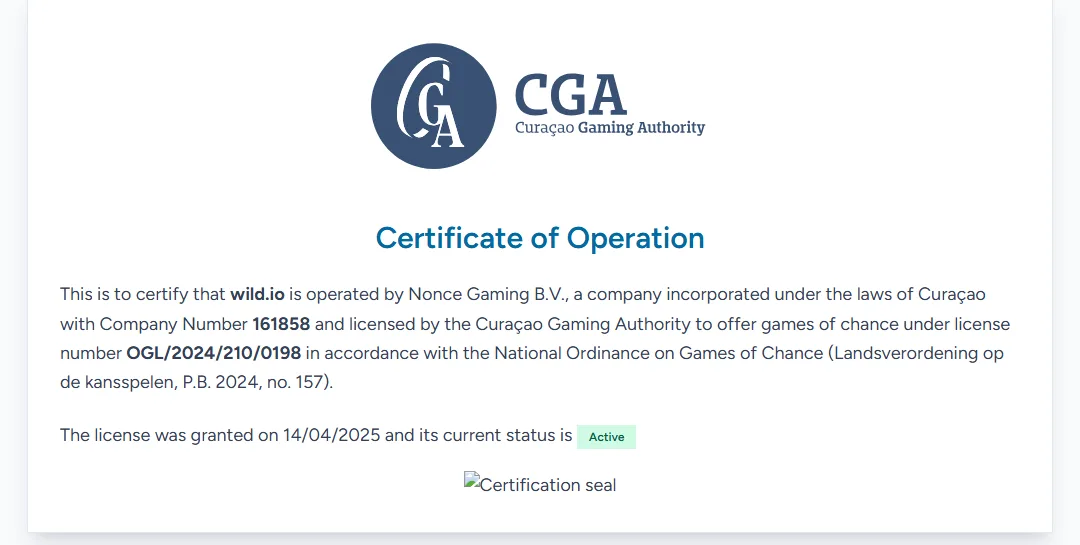
Ten operators sit in the comparison table. Nine carry a license number, and eight of those follow a format that the issuing authority’s current register uses. The ninth, 1668/JAZ, belongs to an older Curaçao series: when we searched the Curaçao Gaming Authority portal for rocketpot.io on 13 September 2026, the certificate page read Not Valid. The tenth publishes no number anywhere, and that cell says “no number” rather than being left to look like an oversight.
Two authorities account for most of the set: four licenses from the Curaçao Gaming Authority and four from the Anjouan Gaming Board.
The remaining two name only the jurisdiction, “Curaçao”, without naming the body that issued anything.
Identity checks are written down in two very different ways. Two operators state a figure — a sum above which documents are required — and give the clause it sits in.
The other seven describe the same duty as risk-based or as a matter for the company’s discretion, which means documents may be asked for before any payout at all.
The table separates those as “case by case” for that reason. The tenth, Empire.io, has no terms reading on file at all; only its entry in the Anjouan register is recorded.
An operator that publishes no threshold has not thereby promised there is none; it has only made it impossible for a reader to work out in advance.
Withdrawal ceilings were confirmed with a clause number at four operators. One publishes no ceiling but does publish a level above which the same money is paid out in parts. The other five have no ceiling clause we could find, and those cells are empty.
An empty cell is not “no limit”.
It is a record that we did not find the sentence. How the ranking is scored sets out what an empty cell does to the total.
Where the affiliate relationship is written down
This site has a commercial relationship with one of the ten operators in the table. That row carries an affiliate mark, and the mark is not removed on any screen. The commission is paid when a sign-up happens, and it has no effect on the order of the table.
Order is decided by the number of fields a document confirmed and by what each of those fields reads.
A commission is not a reason to read one operator’s terms more kindly. The affiliate row’s identity-check cell says the same thing it would say for anyone else: the operator publishes no threshold. Operator checks were run in the same sequence on all ten.
Who writes this
A small editorial team writes the site, and we do not publish the individual writers’ names. We publish what can be checked instead: which document was opened, on what date, and which clause was quoted from it.
For a reader trying to verify a claim, the address of the document is worth more than the name of the person who read it.
For a Korean reader that distinction matters more than usual. Every operator in the table holds a license issued abroad, under a procedure and in a language far from the reader, and opening the source document is the check that stays within reach. What safe means here sets out where that check runs out.