 Vave
- Coins supported
- 90
- Withdrawal limit
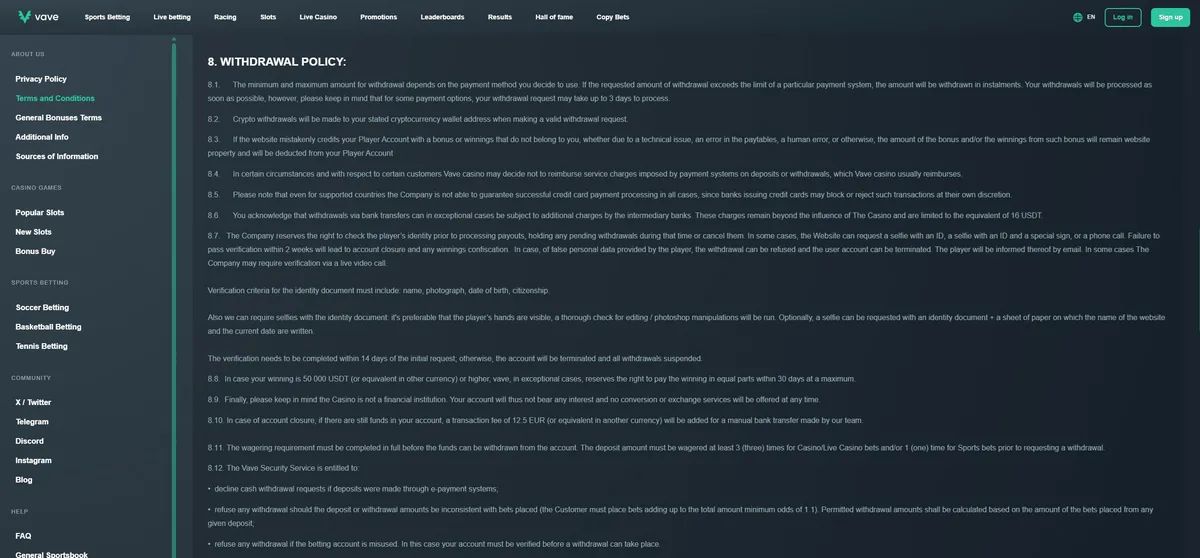
- from 50,000 USDT in instalments cl. 8.8
- Before ID check
- Case by case
- Operator
- Latcas B.V.
- Licence
- Curaçao Gaming Authority
Only two operators write the threshold as a number
Comparing the clauses
Of the 10 operators in the table, 2 state an identity-check threshold as a figure. Seven describe the same duty as risk-based, or as a matter for the company to decide, and one has no terms reading on file.

 Rocketpot
- Coins supported
- 13
- Withdrawal limit
- 5,000 USD per month cl. 11.5
- Before ID check
- US$2,500
- Operator
- Danneskjold Ventures B.V.
- Licence
- Curacao
 Bitcasino.io
- Coins supported
- Not read
- Withdrawal limit
- 1,000,000 USDT per week cl. 6.10
- Before ID check
- 2,500 EUR
- Operator
- Moon Technologies B.V.
- Licence
- Curaçao Gaming Authority
 Wild Fortune
- Coins supported
- 10
- Withdrawal limit
- 15,000 EUR per month cl. 11.8
- Before ID check
- Case by case
- Operator
- Metlait SRL
- Licence
- Anjouan Gaming Board
 DuckDice
- Coins supported
- 10
- Withdrawal limit
- Not published
- Before ID check
- Case by case
- Operator
- Zentari Limitada
- Licence
- Anjouan Gaming Board
 Empire.io
- Coins supported
- Not read
- Withdrawal limit
- Not read
- Before ID check
- Not published
- Operator
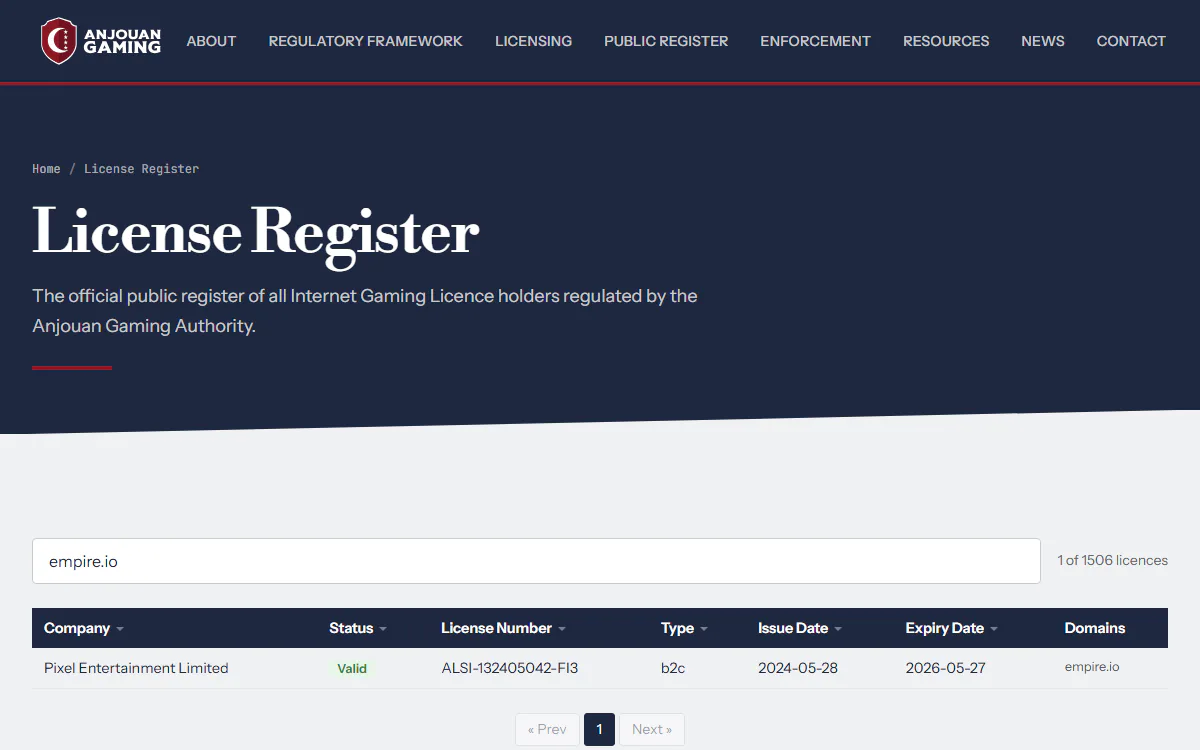
- Pixel Entertainment Limited
- Licence
- Anjouan Gaming Board
 Metaspins
- Coins supported
- 8
- Withdrawal limit
- Not published
- Before ID check
- Case by case
- Operator
- Metaspins N.V.
- Licence
- Curaçao Gaming Authority
- Coins supported
- 9
- Withdrawal limit
- Not published
- Before ID check
- Case by case
- Operator
- RBGAMING N.V.
- Licence
- Anjouan Gaming Board
 Shuffle
- Coins supported
- 6
- Withdrawal limit
- Not published
- Before ID check
- Case by case
- Operator
- Natural Nine B.V.
- Licence
- Curaçao Gaming Authority
 Wild.io
- Coins supported
- 12
- Withdrawal limit
- 100,000 USD per week cl. 9.6
- Before ID check
- Case by case
- Operator
- Nonce Gaming B.V.
- Licence
- Curaçao Gaming Authority
The two that print a figure
An identity check becomes a problem at the withdrawal, not at sign-up. So the sentence worth finding is in the terms, not on the registration screen. Of the 10 operators here, 2 put a figure in it. Their figures sit side by side in the crypto casinos for Korea table.
What those two wrote reads as follows. One puts it at 2,500 US$ in clause 11.4, the other at 2,500 euro in clause 6.6. The tenth operator, Empire.io, has no terms reading on file, so its cell stays empty.
The clause number matters as much as the figure. A number on its own has no address; a number with a clause can be opened and read by anybody.
That is why a figure without a clause does not enter this table.
What the other seven wrote instead
The remaining seven publish no amount. They use phrasing instead: risk-based, at the company’s discretion, where the company considers it necessary.
The crypto casino korea comparison records that state as “case by case”, kept apart from “not published”. Not published means we could not find a sentence on the subject.
Case by case means we found the sentence and the sentence sets no amount.
In practice the difference is small. Either way a reader cannot work out in advance which withdrawal will trigger a document request.
As a record, though, the two are not the same thing, and this site does not flatten them together.
The affiliate row gets the same rule
The top row of the table carries an affiliate mark. Its identity-check cell reads case by case.
Clause 8.7 of those terms lets the company require documents before a payout at its own discretion, and gives 14 days to supply them once asked. No amount appears in that clause either.
Having a commercial relationship does not change how the cell is filled. Changing it would cost the table the only thing it has.
The principle is written down on the editorial team page.
Documents asked for, and what happens to them
The list varies. Some operators want an identity document only; others add proof of address and proof that the payment method belongs to you.
Where a passport is required, a reader holding only Korean-language documents needs time to prepare.
The item that goes missing most often is retention. How long submitted documents are held, and when they are destroyed, is written into few sets of terms.
Where it is absent, a reader has no way to know how long a copy of their identity document survives.
What happens to a balance if documents are refused belongs in the same reading pass. That clause usually sits near the forfeiture wording, and what safe means here shows where to look for it.
How to read the phrase “no verification”
“No verification” is used to mean that no documents are asked for at sign-up. That is true as far as the registration screen.
None of the nine sets of terms we read contains a promise not to ask at the withdrawal. Most contain the opposite sentence: that documents may be required whenever the company thinks it necessary.
So an easy sign-up and an easy withdrawal are separate claims. What actually holds money up at the payout stage is set out in withdrawal limits.
One operator writes down a deadline
How many days you get to supply documents after they are requested is another thing terms can state. One operator in the table does: 14 days, written into the same clause 8.7.
No deadline clause was visible in the other terms we read.
The absence is not a concession to the reader. It runs the other way. Where a deadline exists, whether you met it is the thing in dispute; where none exists, what should have been supplied and by when gets decided afterwards.
The re-submission path deserves the same look. How many times a document can be sent again after being rejected on formatting, and what happens to the balance in between, appears in none of the nine sets of terms we read.